Enter a figure once — Scope 1 emissions, board diversity, an anti-corruption policy — and ESGTrack carries it into every framework it belongs in, with the approvals, evidence, and assurance sign-off a real filing needs.
No credit card required · Most teams are set up the same day
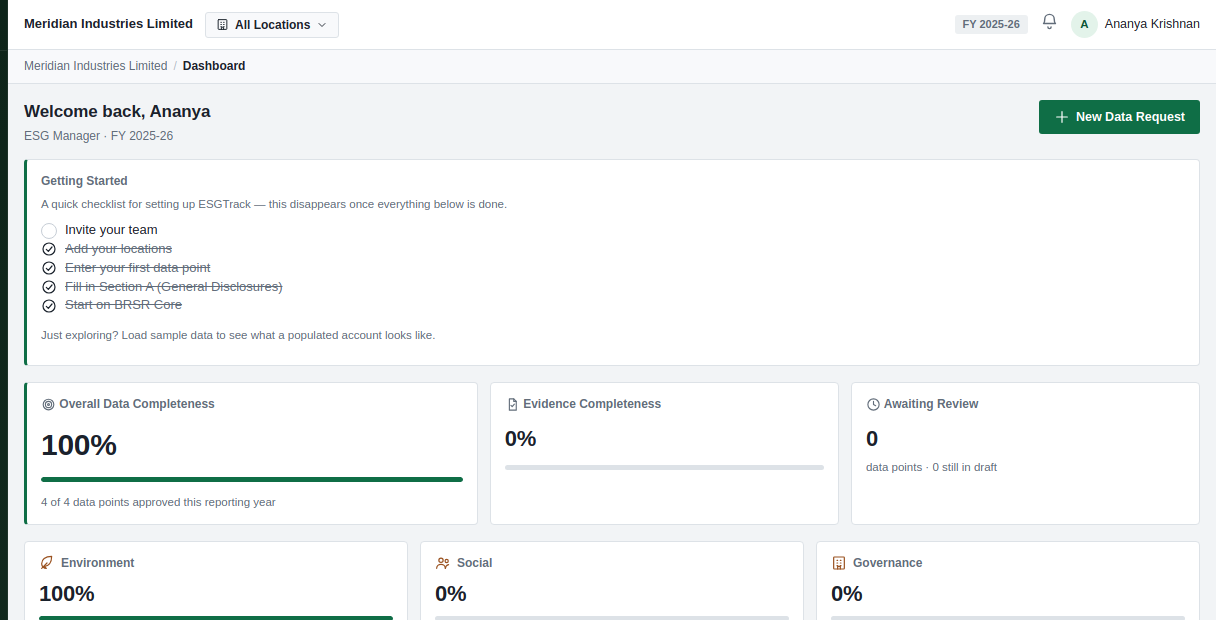
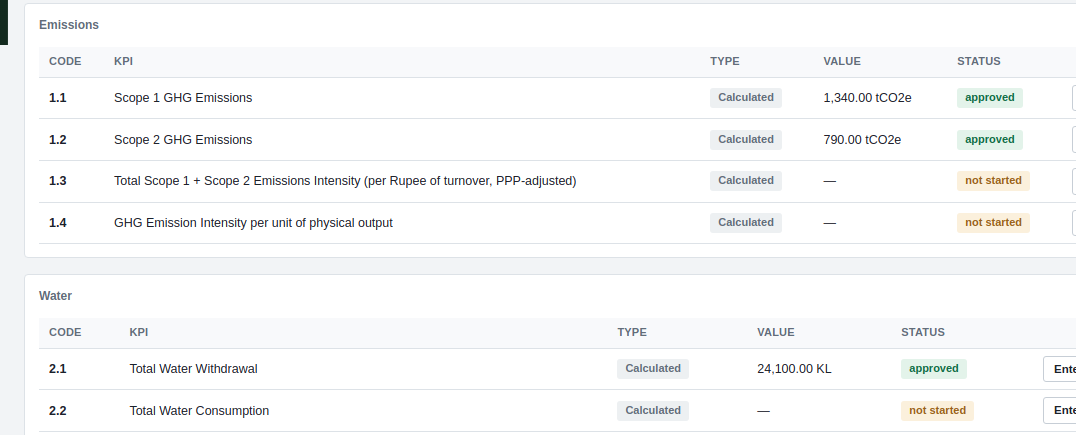
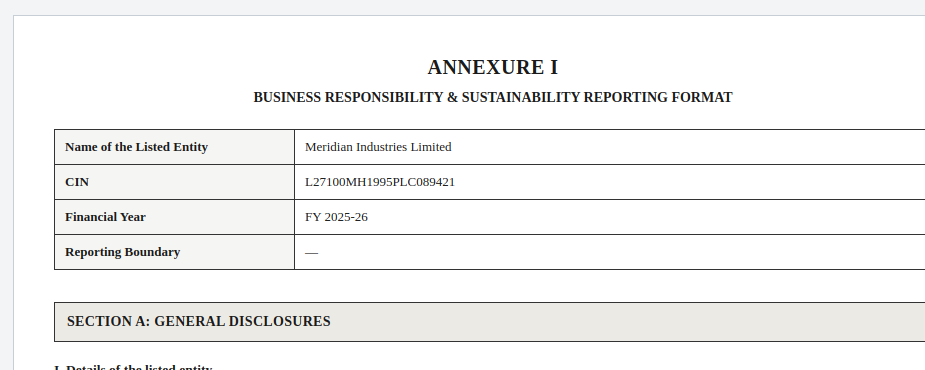
No mockups here — these are actual screens from a working account.
BRSR Core's 38 KPIs, each one either calculated from data you've already approved or clearly marked as not started. Nothing sits at zero pretending to be complete — a reviewer, or an auditor, can tell the difference at a glance.

Assembled straight from the data you've entered, laid out to match SEBI's own Annexure I format line for line. What you see here is what goes in front of your board and your company secretary.

Filling in a form is the easy part. The rest of the work is built in, not bolted on.
Per-location entry across energy, water, waste and workforce data — each figure with a place to attach the document it came from.
Nothing counts as official until someone with the right role signs off, with a variance check on anything that moves sharply year over year.
An approved figure can be carried into BRSR Core and CSRD directly — reviewed against what's on file, not re-typed and hoped to match.
Scope an engagement, invite a read-only reviewer, and manage their queries in the same thread as the data itself.
An assured figure can still be corrected — but only with a reason on record, never a quiet edit.
Link subsidiaries by consent and roll up figures by full, proportional or equity method.
A documented answer to why your report covers what it covers, built from real stakeholder input.
Multi-year trends where a year that wasn't reported shows as a gap — never smoothed over.
Pull disclosures into your own BI tools, or bring in a scheduled export from your ERP with automatic conflict detection.
A lot of ESG software quietly assumes one regulation, one country. If that's not you, the whole product should look different — and here, it does.
The full SEBI filing — Sections A, B and C — plus the 38-KPI BRSR Core subset increasingly under mandatory assurance.
ESRS 2's mandatory general disclosures, plus E1 Climate Change, built against the version currently in force.
IFRS S1 and S2, on the same four pillars TCFD reporters already know: governance, strategy, risk, metrics.
Define your own topics and track what an investor or customer actually asks for — no framework required.
Section A, B and C the way the actual Annexure I lays them out, plus the 38-KPI BRSR Core subset that's increasingly under mandatory third-party assurance. GRI mapping comes along for free, since a lot of it is the same underlying number anyway.
ESRS 2's General Disclosures — the four-pillar structure every CSRD filer reports regardless of materiality — and ESRS E1 (Climate Change), material for close to every company that's ever checked.
IFRS S1 and S2, structured the same way TCFD always was. If your team already reports under TCFD, this will feel familiar rather than like starting over.
Define your own topics, track whatever an investor or a customer questionnaire actually asks about, and skip the regulatory scaffolding entirely.
Enable BRSR, CSRD, ISSB, or none of the above. Your navigation only ever shows what applies to you.
Type it in, upload a spreadsheet, or connect a scheduled export from your ERP.
Your team approves submissions; an external reviewer signs off where it's required.
Generate the document, export what your tagging tool needs, carry forward what hasn't changed.
The details that come up in procurement, listed plainly rather than left for someone to ask.
Every query is scoped to your company at the database layer, never trusted from the browser.
An assurance provider's account can query and comment — enforced on the server, not just hidden in the UI.
OIDC against your own identity provider. No account is created automatically just by logging in through it.
An assured figure needs a written reason to reopen — always on the record.
Every login, logout, and SSO attempt, successful or not — ready for your next IT audit.
Read-only, rate-limited keys that stop working the moment you revoke them.
A single-entity BRSR filing and a five-country group running BRSR and CSRD together aren't the same product to support. Tell us your scope and we'll quote it properly, rather than picking a number that's wrong for most people.
Most teams keep using ESGTrack for the year-round data collection and evidence tracking, then hand the consultant a clean export instead of a folder of spreadsheets in March. Some stop needing the consultant entirely once the report itself generates correctly — that's a call we're happy to leave to you.
ESRS 2 and E1 are built against the version legally in force right now. The EU's July 2026 Omnibus simplification applies from FY2027, with early adoption from FY2026 — we say so directly on the relevant screens rather than quietly building against a draft that might still move.
Everything exports — every disclosure, every report, the full audit trail — at any time. We haven't finalized pricing you don't have a real number for yet, but we're not going to hold your filing history hostage either.
Not yet, and we'd rather say so plainly. CDP restructured its questionnaire in 2026 and we don't trust our own mapping of it yet; full XBRL needs the actual regulator taxonomy files, which we're not willing to guess at. The digital filing export gives you structured data as a head start, not a finished file.
Free to try. No card required.